Thursday, 19 February 2015

Rising Sea Levels


We don’t have to look 85 years into the future to see what a sinking world looks like: 'Rising Sea Levels Are Already Making Miami's Floods Worse' in Wired magazine.

'Based on what scientists can glean from sea level data from the past 20,000 years, [University of Miami's Department of Atmospheric Sciences researcher Brian] McNoldy estimates that the world could still have up to 100 feet of sea level rise to go. He believes even if humans were to slow down or stop the man-made factors contributing to climate change, "we're already pretty well committed to significant sea level rise. We would be more prudent to consider how to adapt to those conditions.'

Beyond the Thames Barrier


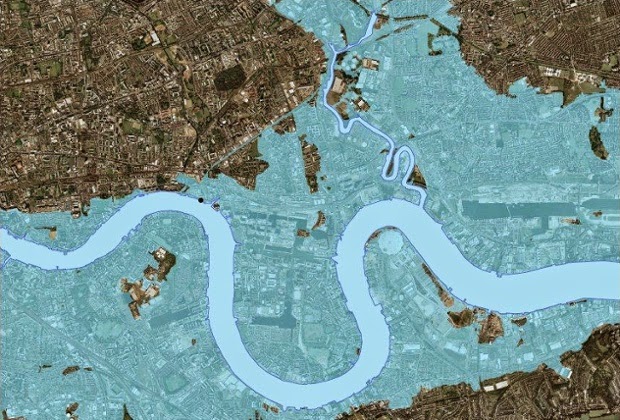
The Guardian on 'Beyond the Thames Barrier: how safe is London from another major flood?'.

'The planners have put mitigating the effects of climate change at centre stage. They expect it to produce raised average sea levels, surge tide levels and wave heights in the coming decades, albeit by less than previously thought. Meanwhile, land levels in the south-east of England are falling – only by about 1.5mm a year, but over the course of a century it all adds up. In addition, development along the river’s banks is slowly invading its space, leaving less room within which its waters can expand.'

Thursday, 13 November 2014

Lost Coast


From Lost Coast an American documentary 'shot against the backdrop of California's most remote coastal region'.

Thursday, 14 August 2014

'Historically, the mitigation of coastal storms has focused on the use of intensive structural solutions — single-purpose engineered barriers designed to protect against often inadequately modeled storms. Once these engineering feats realize their massive physical form, the public develops an attitude of complacency and invincibility against storm events. They are “behind the wall”. The submitting team references this phenomenon as the “moral hazard” where a false sense of security results in more coastal development, subpar construction standards, inadequate policy, and greater public risk.'

Coastal Roulette

Wednesday, 6 August 2014

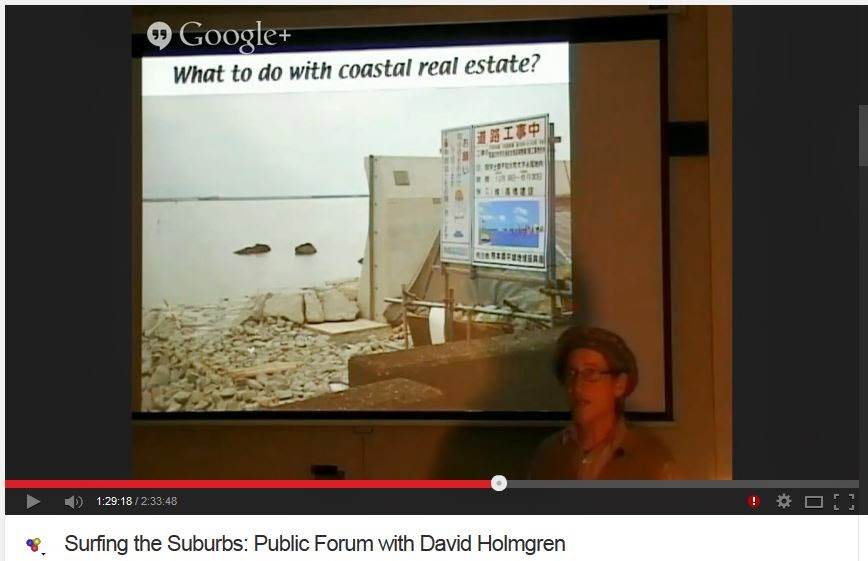
What to do with Coastal Real Estate?


David Holmgren exploring future scenarios: http://youtu.be/PQyw-2V37uw?t=58m

There's more on this topic in the latest John Michael Greer blogpost, Dark Age America: The Rising Ocean, wherein he discusses marine transgression:

'So far, at least, the vast East Antarctic ice sheet has shown only very modest changes, and most current estimates suggest that it would take something far more drastic than the carbon output of our remaining economically accessible fossil fuel reserves to tip it over into instability; this is a good thing, as East Antarctica’s ice fields contain enough water to drive sea level up 250 feet or so.  Thus a reasonable estimate for sea level change over the next five hundred years involves the collapse of the Greenland and West Antarctic sheets and some modest melting on the edges of the East Antarctic sheet, raising sea level by something over 50 feet, delivered in a series of unpredictable bursts divided by long periods of relative stability or slow change.

The result will be what paleogeographers call “marine transgression”—the invasion of dry land and fresh water by the sea. Fifty feet of sea level change adds up to quite a bit of marine transgression in some areas, much less in others, depending always on local topography. Where the ground is low and flat, the rising seas can penetrate a very long way...'

Friday, 11 July 2014

London Permaculture Festival 2014

Managed Retreat issue 1, edging out of frame top right at the 2014 London Permaculture Festival.